

From Data to Strategy: Unlocking the Value of Workplace Insight
Date
16 September 2026
Read length
9 min
The challenge isn’t collecting workplace data. It’s knowing what to do with it.
Our latest Occupier Insights survey suggests many organisations are facing the same challenge. While workplace leaders have access to more workplace data than ever before, translating that information into confident, evidence-based decisions remains a challenge.
With rising costs, evolving workplace expectations and lease events approaching for many occupiers, understanding how their space is being used today and what it needs to support the future has never been more important.
Why evidence matters more than ever
Today’s workplace leaders are balancing a complex list of priorities.
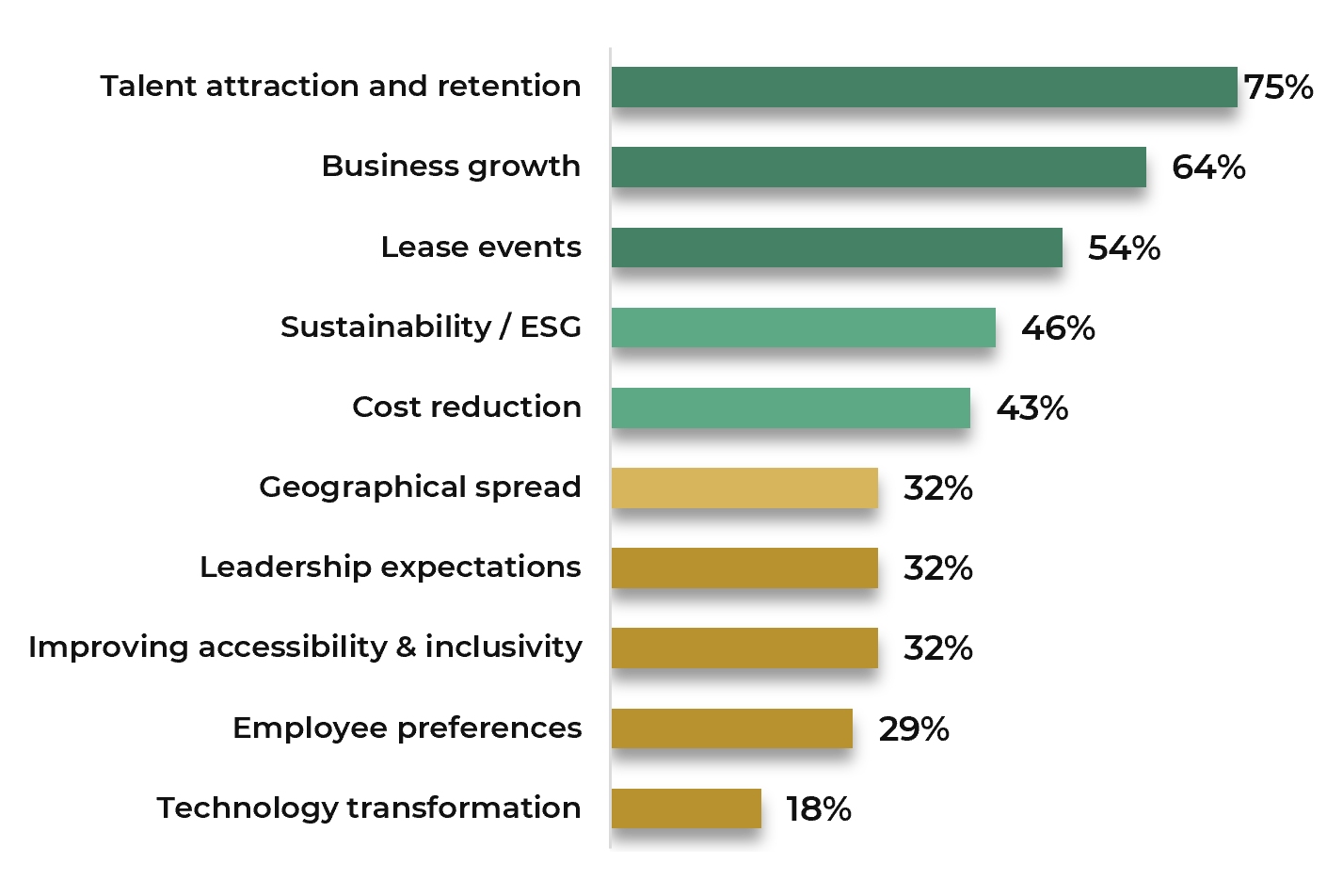
75% of workplace experts cited talent attraction and retention as a key driver for their workplace strategy, while 64% are driven by business growth, and 54% are simply influenced by lease events. 46% are making workplace decisions driven by sustainability / ESG, and 43% are actively seeking cost savings.
These competing priorities make evidence-led decision making essential.
As one respondent noted when asked about the biggest workplace challenge they expect to face over the next two years:
“Getting the right data to implement the right changes within the office so staff can be the best version of themselves in the workplace.”
Most companies already have valuable information at their fingertips. The challenge is translating that information into meaningful recommendations that support both business goals and employee experience.
The utilisation challenge
At first glance, the answer seems simple. If a workplace is underutilised, the assumption is you probably have too much space.
But the reality is rarely that straightforward.
Many organisations are seeing areas of their workplace sit empty on some days, while meeting rooms, collaboration areas and desks are under pressure on peak days. 53% of workplace leaders believe their workplace is underutilised, while only 11% consider their space overutilised.
The findings suggest many organisations may be relying on ‘average utilisation’ as a measure of workplace performance. Yet a workplace can appear underutilised overall while still experiencing pressure on peak days, within specific teams or across particular work settings.
Understanding how, when and why people use space is often more valuable than simply measuring how much of it is occupied.
Across Claremont’s workplace Space Utilisation Studies completed over the last 12 months, we found an average desk utilisation
29%
Across Claremont’s workplace Space Utilisation Studies completed over the last 12 months, we found peak utilisation averaging
52%
Underutilisation doesn’t necessarily mean there’s too much space. In many cases, it points to an imbalance between supply and demand, with some areas sitting vacant while others come under pressure, particularly on peak attendance days.
Many occupiers told us their biggest challenges are:
Many organisations assume they have a space problem when the real challenge is understanding how different teams use the workplace throughout the week. Team days and attendance mandates can create pressure on peak days while leaving space underused at other times, distorting utilisation figures and the assumptions built around them.
Understanding behaviour across teams, departments and days of the week provides a far clearer picture of workplace demand and workplace performance.
The real question isn’t how much space do we have? It’s whether we have the right space, in the right places, to support the way people actually work.
Data is shaping workplace decisions
A lease event, relocation or refurbishment can lock organisations into decisions that will shape employee experience, costs and business performance for years to come.
The cost of getting workplace decisions wrong can be felt for years through unnecessary property costs, constrained growth, poor employee experience and hindered culture.
That’s why workplace data is playing an increasingly important role in real estate decisions.
One leader identified the biggest challenge they expect to face in the next 2 years as:
“Right-sizing and justifying the physical workplace against utilisation data.”
With another occupier saying the biggest challenge they expect to face is “outgrowing our office space as we continue to grow our employee numbers”
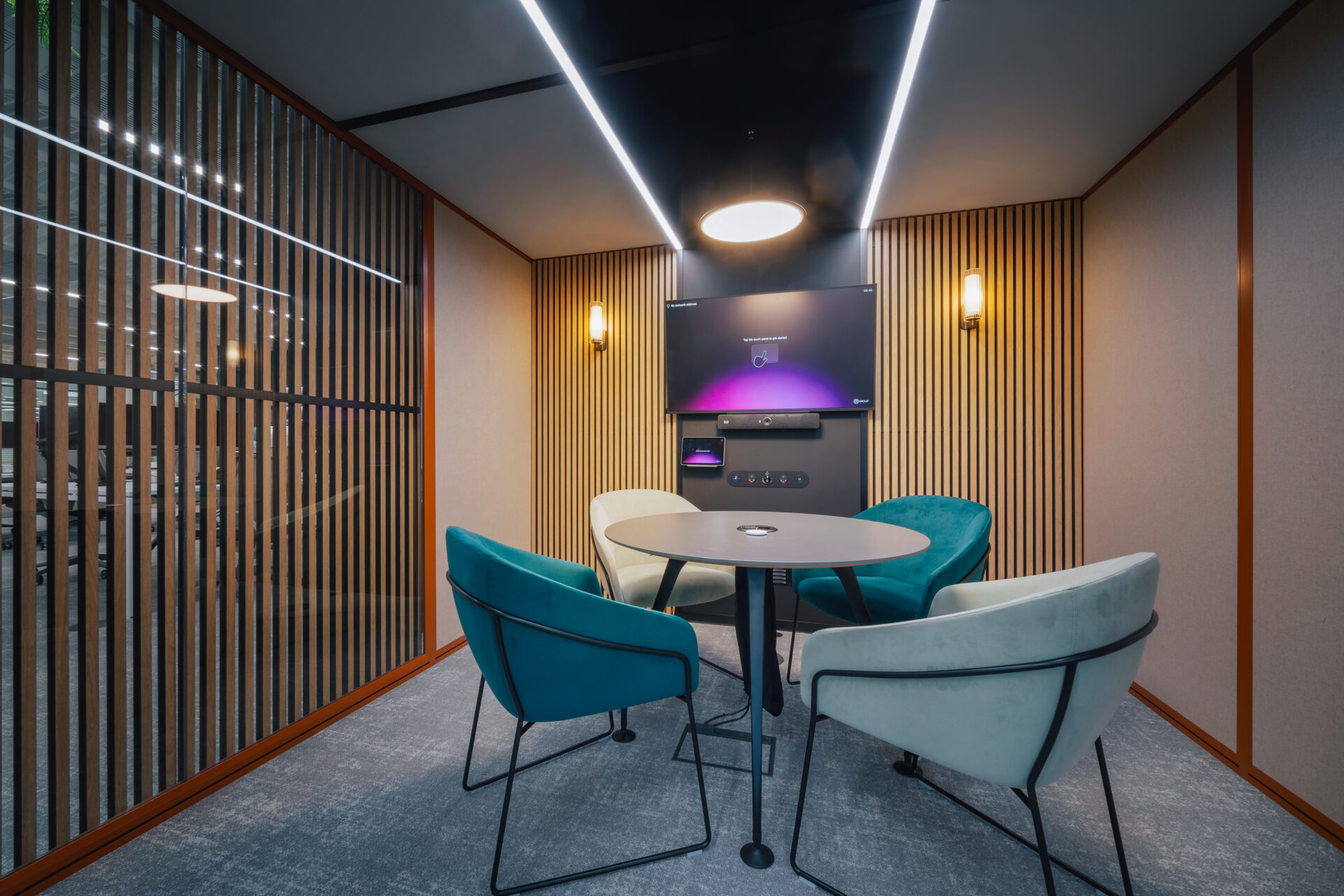
Businesses are also reassessing the work settings they will need. Looking ahead, 68% expect to require more collaboration space, 64% more focus / quiet space and 50% more meeting and training facilities.
These findings point to a broader evolution in workplace expectations. The challenge is no longer simply providing space, but creating environments that support how people work most effectively. The emphasis is shifting from quantity of space to variety, quality, and flexibility.
Organisations are increasingly investing in Destination Offices that bring people together for collaboration and social connection. As a result, desk-heavy layouts are giving way to a broader mix of settings designed around activity and experience. The workplace is increasingly expected to support collaboration, culture and connection in ways that are difficult to replicate remotely.
The shift is clear. Organisations don’t necessarily need more space, they need space that’s better aligned to how their people work.
Without robust evidence, organisations can struggle to answer critical questions:
- Do we have the right amount of space to support our teams?
- Do we have the right mix of spaces to support the way our people work?
- Are our meeting rooms working for us?
- Is our workplace supporting in-person and hybrid collaboration?
- Is our workplace helping us attract and retain talent?
- Can we optimise our workplace without affecting employee experience?
- How do we accommodate future growth while remaining efficient?
These are important decisions with long-term consequences, particularly when they’re linked to lease commitments and significant investment.
Looking beyond utilisation
So, does high utilisation equal workplace success?
Not necessarily.
A workplace can be busy but not supportive. Equally, a workplace with lower occupancy might be delivering excellent outcomes for its people and business.
Ultimately, workplace performance should be measured by the outcomes it delivers, including employee experience, organisational culture and alignment with business objectives.
As one business leader put it, the success of an office refurbishment or relocation is measured by ‘it’s impact on retention, attraction and productivity of our people.’
This is why workplace analytics should be complemented by employee and stakeholder engagement. Understanding what is happening is important, understanding why it is happening is what leads to better decisions.
Occupancy is an output. Workplace performance is the outcome.
Turning workplace data into workplace outcomes
This is where many organisations get stuck.
They have attendance data, booking data and utilisation studies. Yet they still need to make high-value decisions on workplace size, interior design, investment priorities and future real estate strategy.
As our Occupier Insights findings demonstrate, the challenge is no longer collecting workplace data. It’s understanding what that data means for people, performance and the future of the business.
For organisations approaching a lease event, relocation or workplace transformation programme, translating workplace insight into a clear strategy remains one of the most significant challenges.
Workplace insight isn’t just data collection. It’s the ability to connect workplace evidence with employee needs, business objectives and future real estate decisions.

At Claremont, we help organisations turn workplace data into confident, evidence-based decisions. Our Workplace Consultancy team combines utilisation studies, workplace analytics and stakeholder engagement to build a clear understanding of how your workplace is performing today and what it needs to support your people in the future.
By analysing your existing data sources, from swipe access records to desk and meeting room booking data, we validate and build upon these insights through detailed observational studies, uncovering the workplace behaviours, utilisation patterns and trends that sit beneath the headline figures. We then layer in business growth plans, projections and lease timescales to ensure every recommendation supports both immediate needs and long-term objectives.
Alongside this, we engage directly with employees and stakeholders through workshops and surveys to understand not only what is happening in the workplace, but why. Bringing together these quantitative and qualitative insights, our Workplace Consultancy and Design teams translate the evidence into clear, actionable recommendations, helping you define the right workplace size, variety of work settings, and experiences to support the way your people work.
The result is a workplace strategy tailored to your business and aligned with your vision, backed by robust evidence and shaped to support your people, culture and future ambitions.
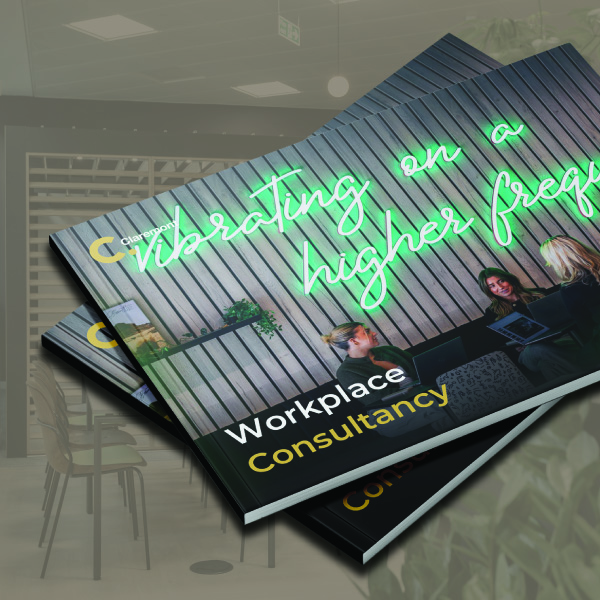
Download our Workplace Consultancy credentials and discover how our team helps organisations turn workplace insight into confident, evidence-based workplace strategies.
Our thinking
Catch up with out latest thoughts on transforming the workplace, and explore our ‘Future Flexible – The Destination Office’ concept

See how we could help with your new office interior design or office design and build project here
Get in touch
We love nothing better than talking all things workplace and design – got a question, potential project or just need some guidance?
Drop us a note…